Bedding · Materials & Mattress Care
What to Look For When Choosing an Organic Mattress
“Organic mattress” sounds like a simple promise. In practice, it can describe only certain materials or parts of a mattress, and the details vary from one design to another. Learn how to read the label, compare construction and certifications, and find a bed that fits your comfort needs as well as your priorities.
Shopping for a mattress is personal enough without having to decode a vocabulary of fibers, foams, and certification logos. Add the word organic and it can get more complicated: Does it refer to the cover, the filling, the latex, or the entire product? What does a certification actually verify? And how do you know whether a carefully sourced mattress will feel right for the way you sleep?
A useful starting point is to treat an organic mattress as a collection of components, not a single claim. A mattress may have an organic textile cover, a natural-fiber comfort layer, a latex core, or a mix of materials. Each layer has its own role and may have its own documentation. Once you look past the headline, you can assess the product more clearly—without assuming that a particular material or label automatically guarantees better sleep or a smaller environmental footprint.
The goal is balance: choose a mattress that supports your body, suits your preferred feel, and provides enough material transparency to answer your questions. The right choice should make sense when you lie down on it and when you examine how it is made and cared for.
Start by asking what “organic” describes
The word on a product page may refer to one ingredient rather than every part of the finished mattress. For example, a cover could be made with certified organic cotton while the support core uses another material. A latex layer might have its own certification, while the fire barrier or inner construction follows different standards. None of this necessarily makes a mattress a poor choice; it means the scope of the claim matters.
Look for a component-by-component description. A helpful materials list identifies the cover fabric, comfort layers, support core, and fire barrier where applicable. It should also explain which components are certified and who issued the certification. If a description uses broad phrases such as “all natural” or “eco-friendly” without explaining the materials, ask for more detail before relying on the claim.
It can help to distinguish between a material’s origin and the finished product’s attributes. “Natural latex,” for instance, identifies a material category; it does not, by itself, tell you how the material was processed, what the finished mattress contains, or whether it meets a particular organic standard. Likewise, “organic cotton” is more informative when a current certification and its coverage can be verified.
A quick label-reading checklist
- Which specific layers or components are described as organic?
- What are the materials in the cover, comfort layers, support core, and fire barrier?
- Are certifications named, and is their scope explained?
- Can the maker provide documentation or a clear materials breakdown?
- Are care instructions, warranty terms, and replacement guidance easy to find?
Understand the main materials in the mattress
Materials influence feel, temperature, resilience, weight, and care. They can also affect how easy it is to inspect or replace a particular layer. No material works for every sleeper, so it is worth separating what a material is from whether its feel suits you.
Cotton and other natural fibers
Cotton is commonly used in mattress covers and quilting. Its feel and performance depend on how it is woven, layered, and finished. Wool may appear in quilting or as part of a fire-barrier system, while other fibers may be used for cushioning. Ask whether a material is organic, whether the claim is certified, and exactly where it appears in the construction.
Natural fibers may be appealing to shoppers looking for a particular material profile, but they do not make a mattress maintenance-free. Covers can be spot-clean only, and some fibers cannot be exposed to moisture or heat. Read care directions before purchase, especially if spills, pets, or frequent laundering are part of your household’s reality.
Latex
Latex is used in comfort and support layers. It is often described as responsive or buoyant, though the feel depends on the layer’s firmness, thickness, and construction. A mattress may use Dunlop latex, Talalay latex, or a combination. Those terms describe different production methods; they do not alone determine whether a mattress is comfortable or suitable for a given sleeper.
For a latex mattress, find out whether the latex is certified and whether the certification applies to the latex layer itself. Also check how the mattress is assembled. Some designs use a single fixed core; others have separate layers that can be rearranged or exchanged. A customizable construction may be useful if you want to adjust firmness, but it also makes it important to understand the available configurations and any exchange conditions.
Foam, coils, and hybrid construction
Organic labeling does not automatically mean a mattress contains no foam, metal, or synthetic components. Some mattresses combine materials to create a particular balance of contouring, springiness, and support. If the product is a hybrid, ask what the comfort layers are made from and how the coil unit is constructed. If a material is not disclosed, do not assume it is organic—or assume it is harmful. Seek specifics instead.
Construction also affects how a mattress behaves over time. A layered design may allow some components to be replaced or adjusted, while a one-piece structure may be simpler to set up. Consider the practical trade-off alongside material preferences.
Learn what mattress certifications can—and cannot—tell you
Certifications can help make material claims more specific, but different programs assess different things. Some focus on organic agricultural inputs or textile processing. Others evaluate chemical emissions or restrict certain substances. A certification logo is not a universal approval of every aspect of a mattress, and one credential should not be treated as interchangeable with another.
For example, GOTS is associated with organic textiles and processing requirements within its defined scope. GOLS is associated with organic latex. OEKO-TEX® programs address testing for specified substances under their respective criteria. The precise standard, version, and scope matter, so check the certifier’s current information rather than relying on a logo alone.
When reviewing a claim, ask whether the certificate applies to a raw material, a textile, a manufacturing facility, or the finished article. A certified cover does not automatically certify the mattress core. Similarly, a material certification does not necessarily address durability, comfort, or every chemical used in every component.
It is also reasonable to ask for a certificate number, the name of the certifying organization, or documentation that identifies the product or material covered. Reputable claims should be explainable in plain language. If a company says a mattress is “certified organic,” it should be able to say what is certified and what is not.
- Check the exact standard. Similar-sounding labels can have different requirements.
- Verify the scope. Confirm whether the claim covers a fiber, latex layer, facility, or whole product.
- Look for current documentation. Standards and certificates can change or expire.
- Avoid overreading a logo. A certification addresses defined criteria, not every possible question about a mattress.
Choose comfort before you fall for the label
A mattress can have appealing materials and still feel wrong for your body. Firmness is subjective, and labels such as “medium” are not perfectly consistent from one maker to another. Your body weight, sleep position, preferred pressure relief, and the way you share a bed can all shape what feels supportive.
Side sleepers often pay close attention to pressure at the shoulders and hips. Back sleepers may focus on whether the mattress supports the lower back without feeling overly rigid. Stomach sleepers commonly need a surface that limits excessive sinking through the midsection. These are useful starting points, not rules: people vary, and many change positions during the night.
If possible, test the mattress in a way that reflects your real sleep habits. Spend enough time in your usual positions, and notice whether you feel comfortably supported rather than simply cushioned. If you share a bed, consider differences in firmness preferences and movement. A split or customizable design may address those differences, but make sure the configuration is available in your size.
Check the trial period and return policy before ordering. Read the terms carefully: fees, required break-in periods, pickup arrangements, and the condition of the mattress can all matter. A generous-sounding trial is most useful when its conditions are clear. For customizable models, confirm whether changing a layer is handled differently from returning the entire mattress.
Match mattress construction to your sleep needs
Beyond firmness, consider how the mattress handles movement, edge use, airflow, and the support you prefer. A layered latex design can feel springy and responsive; an innerspring or hybrid may have a more buoyant character; other constructions can offer a closer, slower response. These broad descriptions are not substitutes for testing, but they can help you decide what to compare.
Couples may want to ask about motion transfer and whether each side can be configured separately. People who sit on the edge of the bed to dress may want to assess edge stability. If you sleep warm, look at the whole construction rather than assuming that one breathable cover guarantees a cool night. Room temperature, sheets, blankets, and personal sleep patterns also contribute to perceived warmth.
Foundation compatibility is another practical detail. Confirm the mattress can be used with your existing platform, slatted frame, or adjustable base, and follow the manufacturer’s spacing and support requirements. An unsuitable base can affect comfort and may influence warranty coverage.
Consider a real-world example of transparent construction
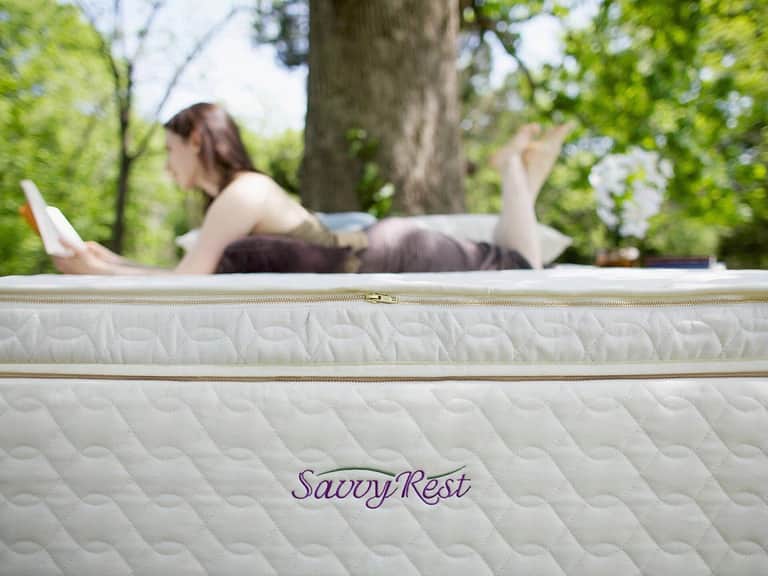
The Savvy Rest Unity Pillowtop Latex Mattress illustrates why it is useful to look at the layers rather than stopping at the product name. Its listed construction combines a three-layer Serenity mattress with a separate Harmony topper, for a total height of 13 inches. The available layers can be selected in soft, medium, or firm, and the Queen and King sizes can be customized by side.
According to its product details, the mattress uses a certified organic cotton outer casing, certified organic Dunlop latex in the mattress layers, and certified wool as a flame barrier. The topper uses Talalay latex. The maker also describes a 90-day layer-exchange policy and a 20-year limited warranty. Those details give a shopper concrete questions to investigate: which certificates cover each component, how the layer choices affect feel, what the exchange policy requires, and how the cover should be cleaned.
This is not a universal template for an organic bed, nor a guarantee that the mattress will suit every sleeper. It is an example of the kind of information that makes comparison more meaningful: identifiable materials, construction details, customization options, and care and warranty terms. Always confirm current product specifications and policies directly before making a decision.
Think about durability, care, and the mattress’s next chapter
Buying a mattress is a long-term household decision. A product’s useful life depends on its construction, how it is used, its foundation, and how well it is maintained. Organic materials do not make a mattress immune to wear. Check the warranty for what it covers, how long it lasts, and what conditions could limit coverage. A warranty is not the same as a promise that the mattress will feel unchanged for its entire term.
Care instructions deserve attention before checkout. Some mattresses have removable covers that are not machine washable; others call for spot cleaning only. Use a mattress protector if the manufacturer recommends one, and make sure it does not interfere with the mattress’s feel or ventilation. For spills, follow the care guide rather than applying cleaners or heat that could damage materials or void coverage.
Ask whether layers can be replaced, whether the mattress can be disassembled for moving, and what options exist at the end of its useful life. Transport, repair, donation, and recycling possibilities differ by region and construction. No mattress is automatically sustainable simply because it contains an organic component. A more complete assessment considers sourcing, manufacturing, durability, repairability, and disposal, while recognizing that detailed impact data may not be available for every product.
How to compare options without getting overwhelmed
Instead of trying to find one perfect label, create a short comparison based on the factors that matter most to you. Start with a comfortable firmness range and a practical budget, then compare the material breakdown and certification scope. Add trial conditions, warranty, care, foundation compatibility, and delivery or setup considerations.
| What to compare | Useful question |
|---|---|
| Materials | What is used in each layer, including the cover and fire barrier? |
| Certifications | Which exact components are certified, to what standard, and by whom? |
| Comfort | Does the firmness and pressure relief suit my sleep position and preferences? |
| Construction | Are layers fixed, replaceable, or customizable, and how does that affect setup? |
| Care | Can the cover be washed, or is spot cleaning required? |
| Ownership | What do the trial, return policy, warranty, and end-of-life options actually allow? |
Use the same questions for every candidate. That makes it easier to compare like with like and less likely that a polished product description will distract from an important missing detail. If the information is unclear, contact the manufacturer or retailer and keep the answer with your purchase notes.
Common assumptions worth questioning
- “Organic means every part is organic.” Not necessarily. Find out which components the claim covers.
- “A certification proves the mattress is best for me.” Certifications address defined standards, not personal comfort or sleep outcomes.
- “Natural materials are always cooler.” Temperature depends on the complete mattress, bedding, room, and sleeper.
- “A firmer mattress is always more supportive.” Support and firmness are related but not identical. Comfort depends on fit and construction.
- “A long warranty means the mattress will never change.” Warranty terms define specific coverage and exclusions; they do not guarantee an unchanged feel.
A thoughtful choice is a well-informed one
Choosing an organic mattress does not have to mean accepting vague promises or navigating every technical detail alone. Focus on what the mattress is made of, which claims are independently documented, and how the construction is likely to feel in your preferred sleep position. Then check the parts of ownership that are easy to overlook: care, foundation compatibility, trial terms, warranty limits, and what happens when the mattress is no longer useful.
The best organic mattress is not simply the one with the most impressive-sounding label. It is the one whose materials and certifications are clearly explained, whose comfort suits your needs, and whose care and lifespan make sense for your home. With those questions in hand, you can compare options calmly and choose with confidence—without confusing a marketing phrase for a complete answer.
Frequently asked questions
Is an organic mattress made entirely from organic materials?
Not always. The claim may apply to particular materials or layers rather than every component. Review the full materials list and the scope of each certification.
Which certifications should I look for?
Look for certifications relevant to the material or claim being made, and verify the exact standard and scope. Textile, latex, and emissions certifications address different criteria and are not interchangeable.
Does organic automatically mean a mattress is more comfortable?
No. Comfort depends on firmness, pressure relief, support, construction, and individual preference. Evaluate the feel alongside the materials and the opportunity to test or return the mattress.
What is the most important thing to check before buying?
Start with a clear materials breakdown and confirmation of what any organic claim covers. Then make sure the mattress feels appropriate for you and that the trial, care, and warranty terms are acceptable.